

Alaska experienced a sustained cold spell throughout December, which froze many lakes without snow cover. I tracked satellite imagery and weather forecasts, hoping to find a novel skating destination as soon as the semester ended at Alaska Pacific University, where I was teaching Risk Management in the Outdoor Studies department.
Mid-December is not my preferred time for winter camping. In fact, I’ve never done a trip that time of year. Too cold and too dark.
One challenge was finding a partner who could tolerate darkness from 7 PM to 9 AM, which likely means 12+ hours in a tent together. I was thrilled when Josh Mumm said he could do it. In addition to being incredibly competent, Josh doesn’t mind downtime in the tent. Fifteen years ago, on Denali, we spent a night pinned by high winds, four of us in a two-person tent. Compared to that, winter camping near the solstice would be a breeze.
I spotted the potential for a 100-mile skateable loop on Naknek Lake in Katmai National Park. This was especially fitting because Josh and I carried ice skates through here 7 years ago on a ski traverse—there was too much snow to skate. I drilled extra holes in the skate platforms in case we wanted to use them as snow anchors. You can see the skate hanging from Josh’s harness in this photo:


We walked half a mile from the King Salmon airport to a friend’s empty house, installed the battery in her truck, and drove to the end of the road to look at the ice. The river ice was jumbled, but locked in place. The nearby pond ice was thick!
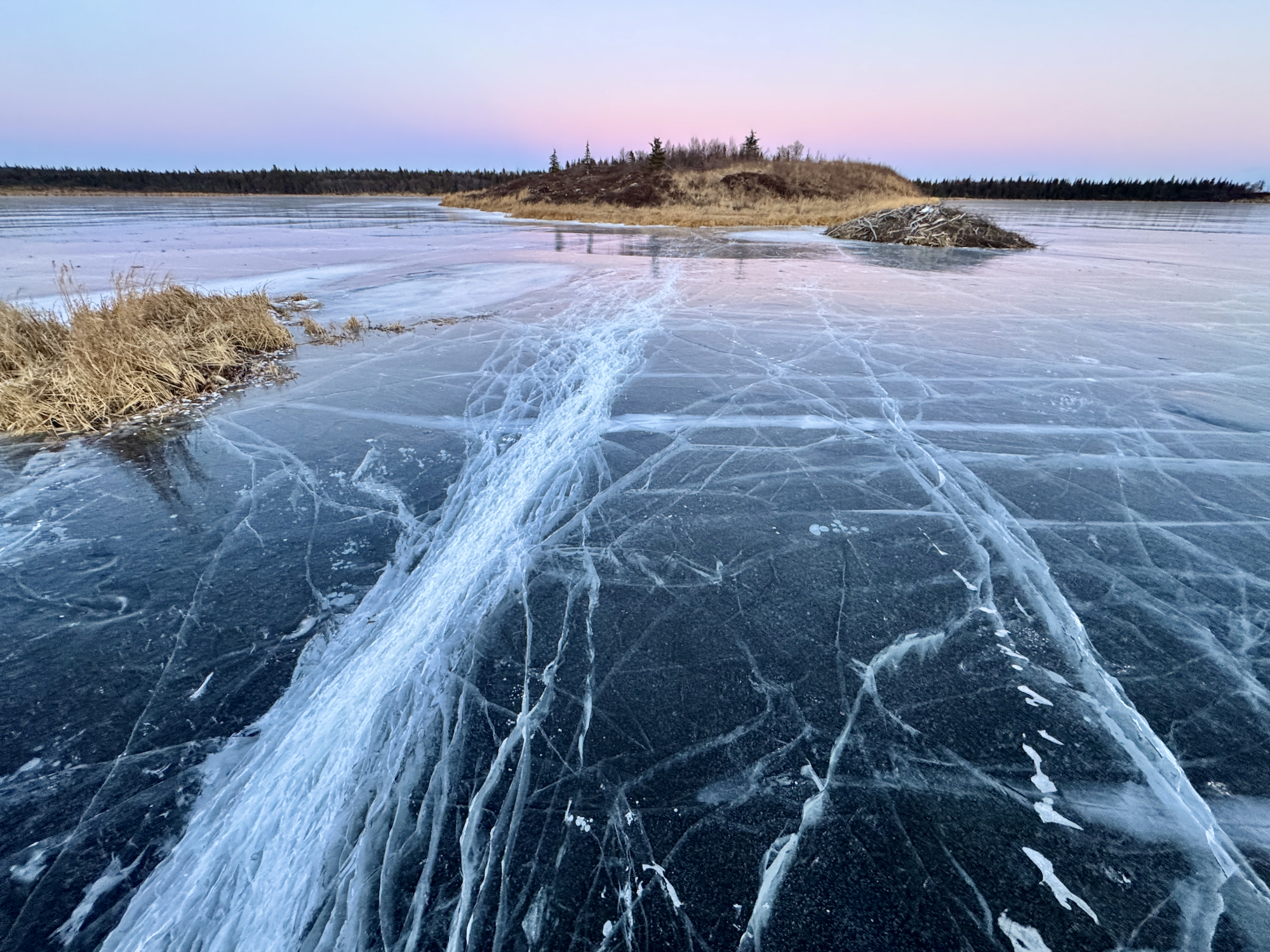

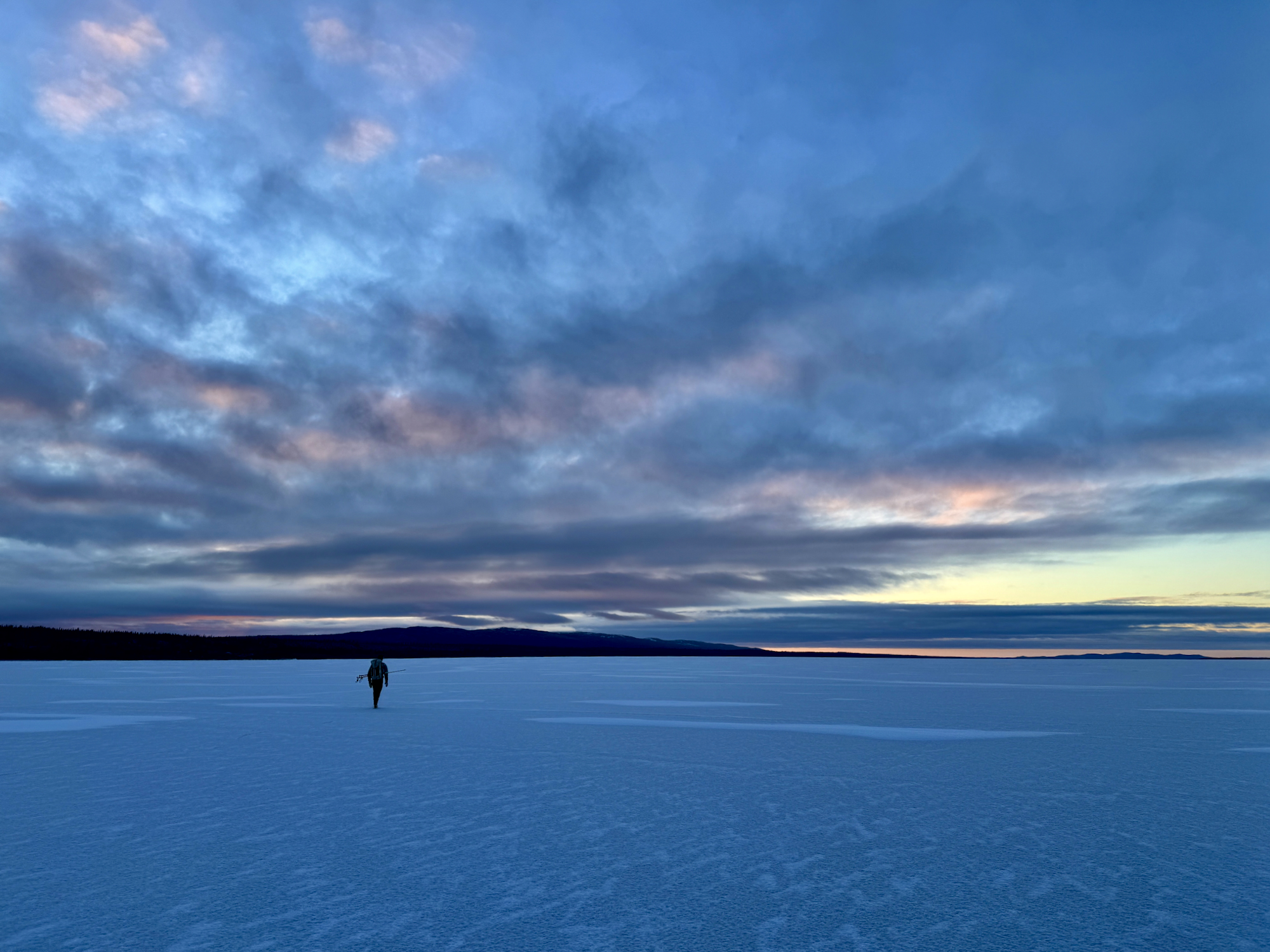
We started the trip the next morning at 9:00 AM, a full 90 minutes before the sun crested above the horizon. Low clouds reflected the sun’s light well before we could see it, creating an orange sky over purple ice. The ice was strong, at least 8 inches (20 cm) thick, and smooth enough. One of my first observations was that it would be hard not to get complacent on such thick ice. This turned out to be true. But first, we got to skate on a bunch of incredible ice.


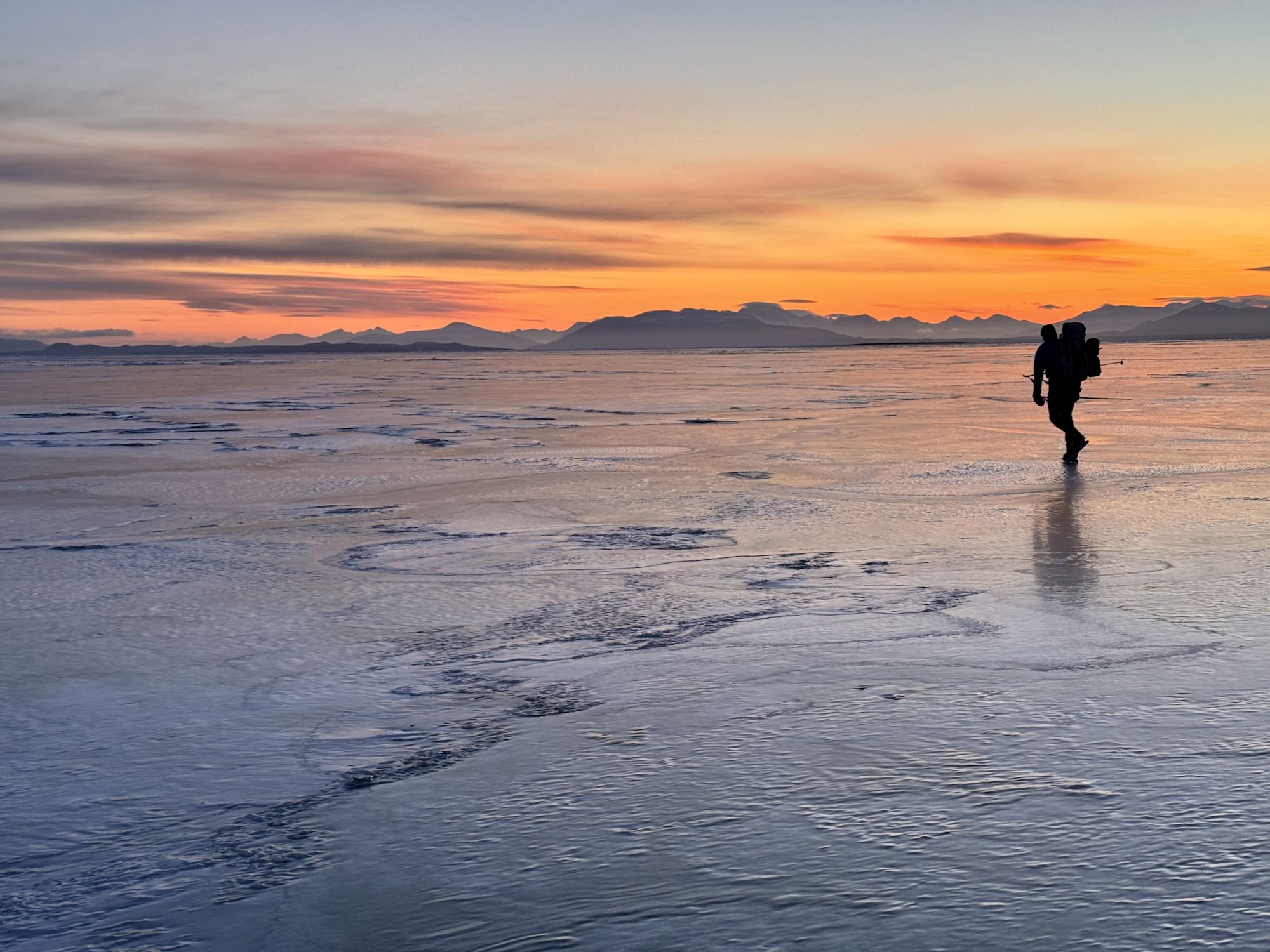


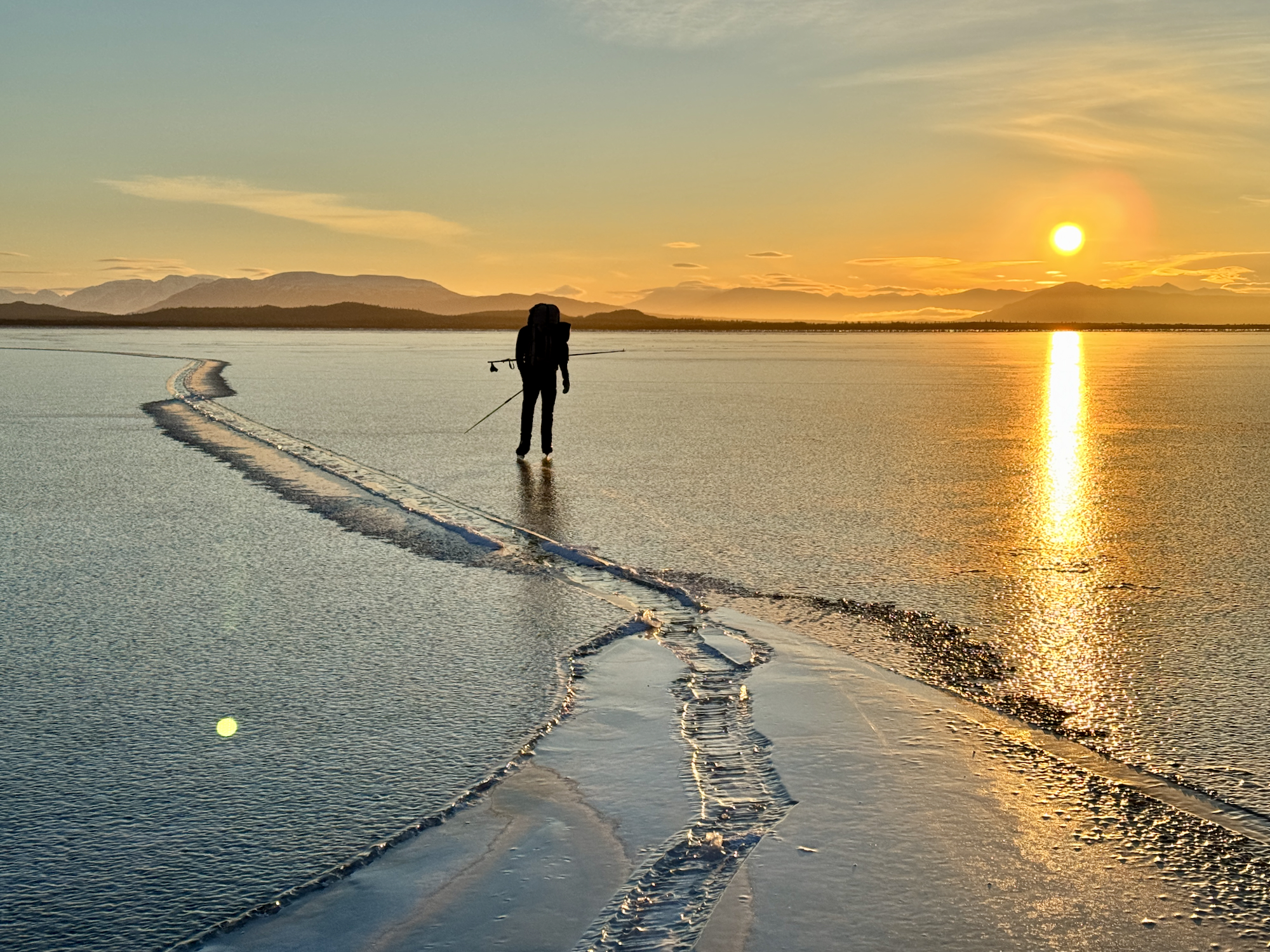

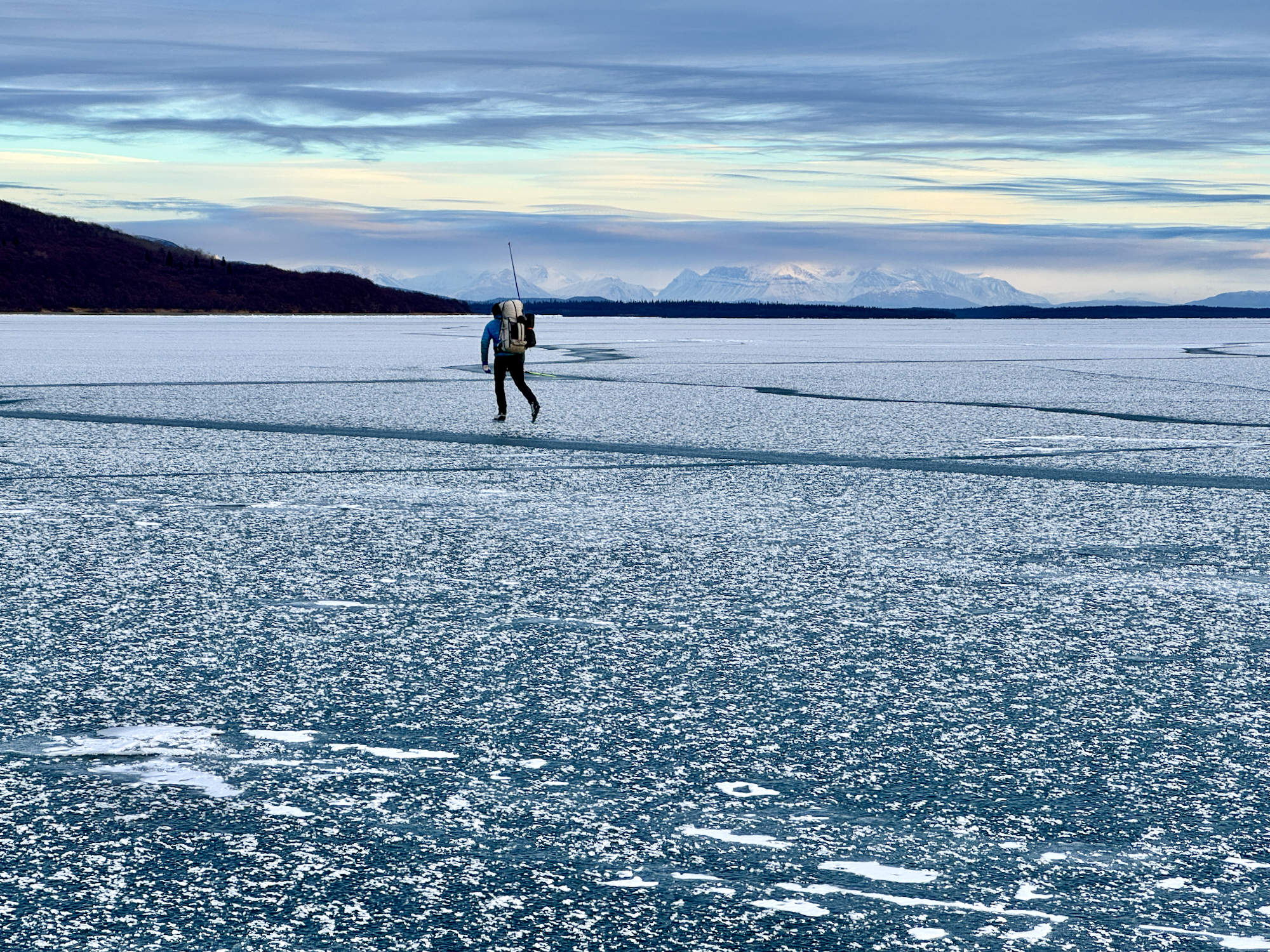
After skating 45 miles (72 km), I skated directly into a pool of open water. We had averaged 7 miles an hour (11 km/h), and that’s probably how fast I was moving—like running an 8:30-minute mile. I was skating on very smooth ice, and impressed that the ice ahead looked even glassier. I reached forward to strike the ice with my testing pole on the fly, but found myself chest-deep in the water. We were in the middle of nowhere.

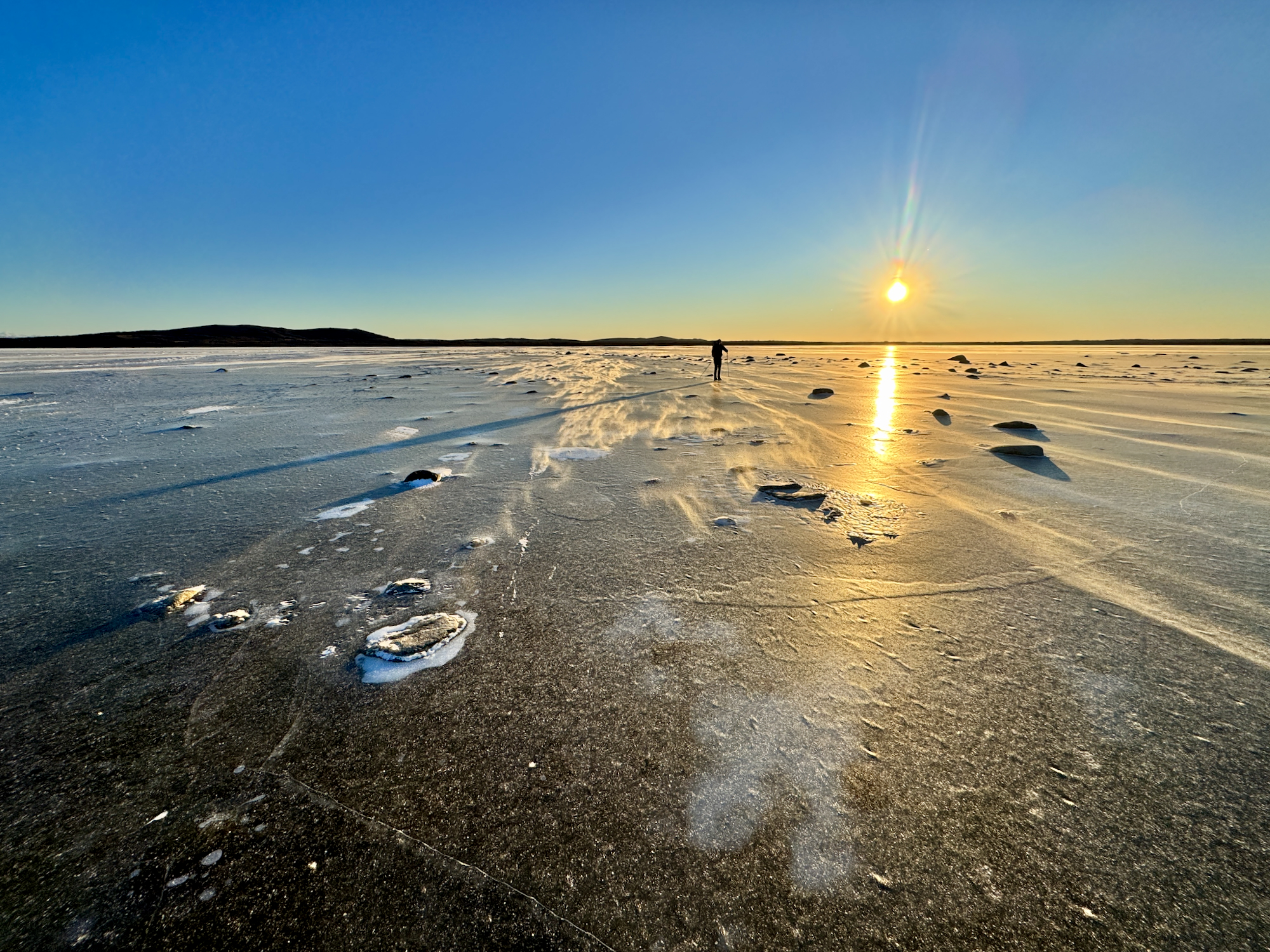
Take a close look at the next photo: Can you spot the open water? I’ll feel better if you say no.

I often state that I am more comfortable on ice than in avalanche terrain because the ice provides feedback in ways that the snowpack does not: “It would be really weird to break through the ice without warning signs—cracks.” Well, I found an exception. This was the avalanche of ice incidents. (The difference is that I didn’t break through thin ice. I found a random zone of open water after 45 miles of 8-12 inch ice.)
I yelled to warn Josh, but he had already stopped before the open water. My momentum had taken me about six feet (2 m) from the ice shelf, and my pack’s buoyancy kept me oriented vertically in the water. I awkwardly swam back to the shelf by kicking my legs and making crawl strokes with my arms. I threw my poles onto the ice shelf, removed the ice rescue picks from my neck, and stabbed the ice. Once I had good traction, I took a moment to collect myself and let Josh know that I was okay.
Several factors were working in my favor. The most significant was that my face didn’t get wet. Exposure to cold water, especially on the face, often triggers a gasp reflex, making it difficult to breathe normally, which in turn triggers panic.
The reason my face didn’t get wet was that I intentionally packed my backpack with dry bags to increase its buoyancy. I was careful to keep the waist and sternum straps tight so that the pack would lift me up with its buoyancy. I learned the effectiveness of this strategy by practicing wet immersions. I experimented with different levels of buoyancy, with and without a PFD, drysuit, backpack, etc., and then incorporated these variations into my ice rescue courses.
My next task was to bring my feet into position behind me so that I was horizontal, swimming at the shelf. This was challenging because my skate setup has a free pivot point at the toe, which means the skates act like sails as they drag through the water. But I knew this would be a challenge because I had practiced with this exact setup. I also knew, from my training, that I should have ten minutes to get the job done—ten minutes before the blood moved from my extremities to my core to protect my vital organs. That felt like a lot of time to try Plan A and then come up with Plan B if needed.
I explained to Josh that I was having trouble getting my legs in position, but that I was making progress. Once they were behind me, I reached with my picks, kicked with my legs, and got my chest on the ice. This was hard with a full backpack (we were equipped for two nights of winter camping). With my chest on the ice, it was easy to kick and crawl the rest of the way out of the water. This entire process took about one minute.
Josh asked if I wanted to go directly to shore to start a fire. I said no. Might as well use the set of dry clothes that I’m carrying.
Part of what makes Josh such a good trip partner is his composure. We used a ‘pit-stop’ strategy, where Josh got me onto a foam pad, emptied my pack, and handed me the clothing I asked for so I could focus on dressing. We were incredibly efficient, in part because … I had practiced this. I never got cold enough to start shivering.
In addition to my own practice, I benefit from watching course participants go through this process and getting their feedback. For example, I think it was Becca, this year, who said she was frustrated trying to change into tight baselayers with wet skin. Based on her experience, I packed thin puff pants and a loose top instead of tight baselayers.
When he had a break in activity, Josh found other things to do, like wringing water out of my wet layers. It was cold, probably 5 ºF (-15 ºC), and we had to peel my wet clothing off the ice when we packed up to go. I think it took 10 minutes to change and another 10 to pack back up.
A popular question in this year’s courses was whether it is better to change into dry clothing as soon as possible or to start skating to generate heat. My opinion has always been that it is better to change right away, and this experience strengthens my conviction. Every minute spent in wet clothing results in significant heat loss. Maybe someone can figure out the math: how much heat is lost while moving and wet, vs. 10 minutes of heat loss while changing into dry clothing. The only time I’d consider skating wet is if I’m very close to the car or shelter.
Another reason to change into dry clothing is that there might be more surprises before you reach safety. We should have reached the shore in 5-10 minutes, but were surprised to discover new cracks in all directions. It turns out that we were on a two-mile raft of free ice that was slowly drifting away from the main body of ice! This would have been a bad scenario if I were still wet.
The Ice Raft
We weren’t done yet. During our previous snack break, ten minutes before my immersion, we felt a pressure wave pass through the ice and then heard a bunch of popping and cracking. Josh jumped to his feet. I said, “This ice is so thick, even if it cracks, it can’t go anywhere.” This turned out to be wrong. We tried skating to the north, and then south, but encountered wide cracks, too wide to step over.
The ice under our feet made noises I’ve never heard, and hard to describe. Kind of metallic and hollow. Even without understanding the noises, the caveman part of my brain recognized them as ‘not right.’
We retraced our tracks to the west, where we had come from, and were disappointed to discover new cracks through our tracks. Even more disconcerting, we realized that the cracks were expanding. We were on a free-floating raft of ice, slowly drifting to the east.
It took forty minutes ot navigate our way off the ice raft. We zig-zagged our way through a mile and a half (2.4 km) of thin cracks, most of which we could easily step over. But the final crack was two feet wide (60 cm), which required momentum and a bit of a leap. We considered throwing our packs across, but didn’t want to be separated from the packs. Knowing that the gap was only getting wider, we made a quick decision and leap. Once we were back on shore-fast ice, it took only minutes to reach shore.
Reviewing satellite imagery before and after the trip revealed that the leading edge of the ice was progressively breaking away, and then a large raft, 0.65 sq mi (1.7 sq km), drifted to the east. Near-real-time satellite imagery is available five days before we were there, one day before, and two days after. Here are a few ways to view the progression:
Five days before to one day before:


Our GPS track, Dec. 18, in yellow. Open water is black, upper right. Land is red.
One day before to two days after. Note the distinct white ellipse that you can track within the raft:


Our GPS track, Dec. 18, in yellow. Open water is black, upper right. Land is red.
Or, you can expand and click through these using your arrow keys:


Here’s a close-up of our zig-zag route, trying to get off the raft and back onto solid ice:

And finally, here’s a thermal infrared image showing the warmer ice zone (thinner, light gray) where I took a plunge. White is the warmest (open water), and black is the coldest (land):

And because I can’t help myself … here’s a slider with the thermal layer … check out how it reveals different generations of ice growth: younger ice is thinner and warmer. Note the small zones of warmer temps (thin? open water?) in the east:

I don’t understand the driving forces that caused the raft to form and drift eastward. If there were any current, it would be to the west. It wasn’t a windy day. The forecast was for wind speeds of 3-4 mph, gusts up to 11. I don’t remember any gusts. But it had been very windy in the previous days, blowing from the north and west.
My best guess is that the ice somehow stored the stress from the wind, or that even a very weak wind can apply a significant stress over a 30-mile fetch.
This was a freak incident, one that would be hard to anticipate.
Once we got to shore, Josh collected wood for a fire, and we spent four hours drying my critical layers. It didn’t work to just hang the clothes near the flames; we had to manually tend them. I really appreciated having removable boot liners.


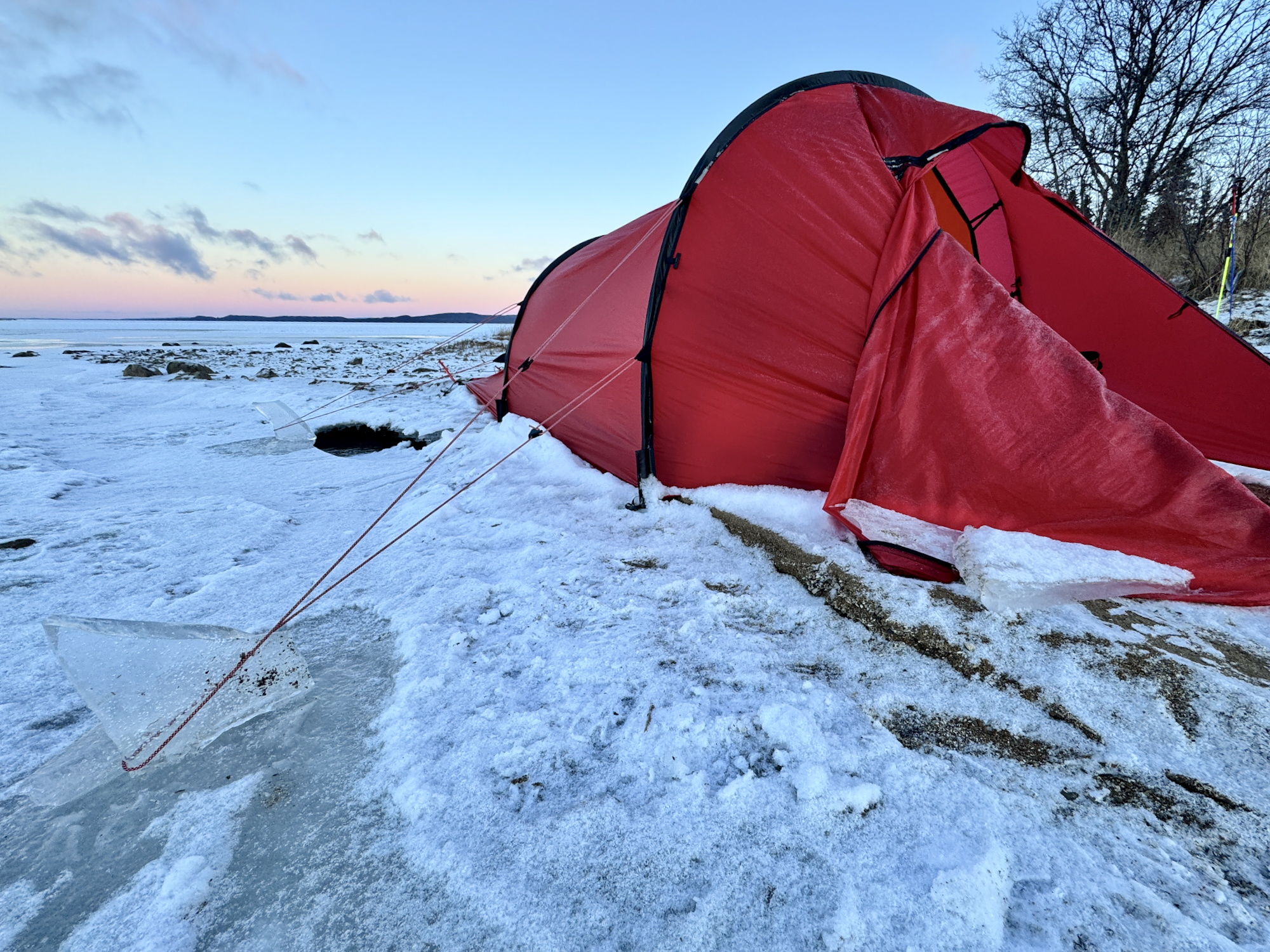
We stayed close to shore the next day, spent one more night out, and completed our 100-mile route.



This immersion could have been very scary and dangerous for someone who hadn’t done as much preparation—even for the ultra-competent Josh. I had practiced skating into open water, using this same equipment. I had my pack loaded with dry bags for extra buoyancy and had my waist and sternum straps tight, so that the pack would lift me up. I had practiced with my rescue picks. I had even modified the picks to make them more retentive and buoyant. (I’ve got more of these in stock and coming, perhaps best to shoot me an email if you don’t see them available on my store page.)
Instead of feeling vulnerable, I felt empowered. BUT … my margins were pretty darn tight. Things would have been very different if the ice shelf had been thin, if Josh had also gone in, if my picks had fallen off, if it had been windy, if there had been any current, and so on. I’m not off the hook. If I want to keep playing the game, I need to keep practicing and making that practice as realistic as possible.
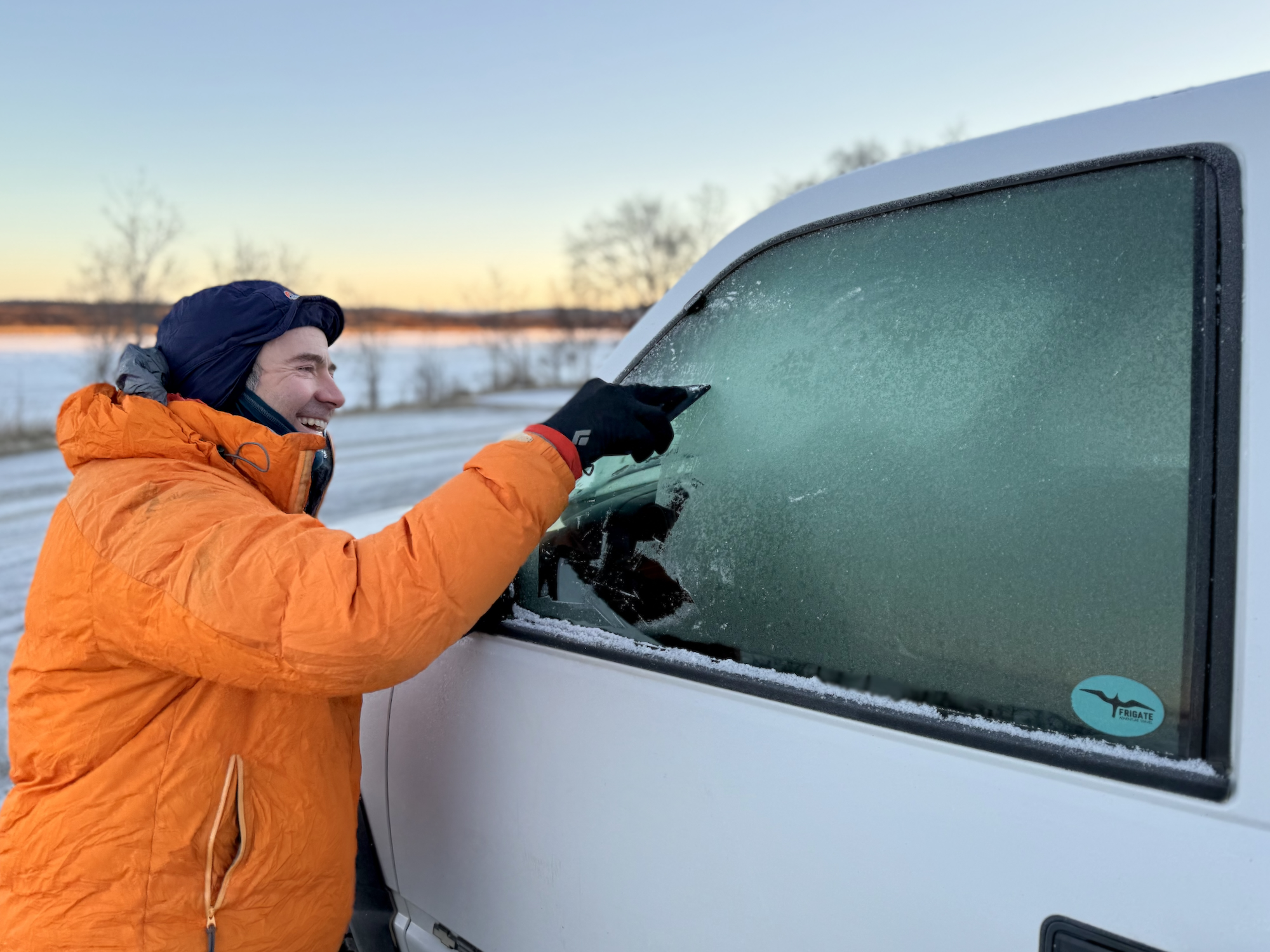
Erica’s truck, the one we borrowed, is mostly used during the fishing season, so we weren’t surprised that it didn’t have an ice scraper. My Kindle did the job. We grabbed burgers in town and then chose Disney’s Planes from Erica’s kids’ DVD selection for our evening entertainment.

My love for traveling throughout Alaska forced me to get good at trip planning and risk management. If you are interested in learning more about skating on natural ice, I have an ongoing online course and seasonal rescue trainings. For general wilderness risk management and trip-planning, check out Start & End at Home. I run this course annually, in February.
Great story, and takeaways, and photos. Thanks for sharing!
What a grand adventure, and spectacular photos! Thanks for sharing!
You make my inbox not shit.
Glad you’re safe. Big hug from Shillong.
What an incredible trip – wild ice skating at a boss level!
We can all learn so much from this, especially that mistakes and unforeseen events can always happen. I’m so glad that absolute professionals were there, prepared for such situations!
Off topic, but looking at the images, is it just me noticing how much more orange our (northern) sunsets have become? Increased atmospheric particulate leftover from summer forest fires? I don’t believe there’s been an increase in volcanic activity to account for this.
Interesting observation! I don’t see enough sunsets (in Anchorage) to have an opinion. But I was sure impressed with the colors on this trip.
That was a nasty surprise but you handled it well Luc. Great that you managed to complete your planned trip