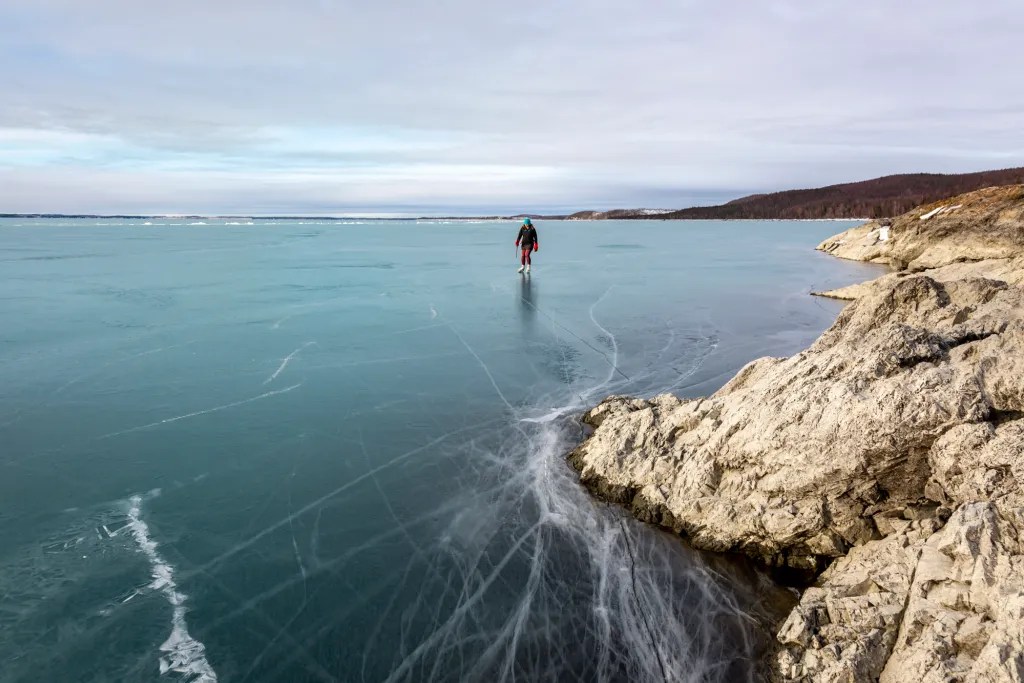
We caught a brief window of skating on Skilak Lake last week. The prominent hazards turned out to be pressure ridges—zones of cracked ice under compression. This post contains:
- The satellite research that led me to believe the lake was skatable
- How to navigate cracks and pressure ridges
- Photos from four days of skating
If you love this stuff … consider joining the online course and newsletter.
First … a highlight reel and some eye candy!


Why I thought that the ice was skatable
I monitor near-real-time satellite imagery hoping to catch windows of good ice. Collection dates and resolutions vary, so I use a few sites as outlined in this post.
As revealed by the satellite imagery, Skilak Lake was snow-covered on January 21st and snow-free five days later.
Here’s what the thaw cycle looked like at the nearest weather station:

Note the three days with temperatures as high as 39 F and wind gusts reaching 31 mph (red circles). Warm winds are a great way to remove snow!
Based on the satellite imagery alone, I couldn’t tell if the lake was open water, water-covered ice, or bare ice. Fortunately, a higher-resolution image became available the next day, January 27th. I zoomed in to the area around the island and noticed cracks! After a quick weather check via windy.com, Sarah and I planned our weekend at the lake. We were joined by Becky King and Tony Perelli, and then Sarah Glaser and I returned Monday and Tuesday.


How to navigate cracks and pressure ridges
Start with this video:

Cracks
Here are the take-home points:
- Dry cracks are not too worrisome; they indicate a weakening of only 10%.
- Wet cracks indicate a weakening of 50%, and at intersections, 75%. Wet cracks should be crossed perpendicular to the crack (Gold, 1971).
These photos show wet cracks that have pushed ice up and out due to compression:


Pressure ridges
Pressure ridges are space problems—there’s too much ice in the area. Pressure ridges are influenced by currents, tides, winds, and thermal expansion and contraction. When cracks fill with water, which then freezes, the ice cover expands and can run out of space. Ice might get pushed up onto the lakeshore or build pressure ridges within in the ice cover. Pressure ridges are dynamic environments that can include open water, thin ice, and other hazards. My closest call of breaking through ice was at a pressure ridge.
Strategies for crossing pressure ridges:
- Travel parallel to the ridge in case it dies out and you can just wrap around the end.
- Use a tool to test the ice’s strength as you search for a crossing. We are big fans of ice poles, which are basically just ski poles with heavy steel tips. Here’s one example. We have throw ropes and other safety equipment on hand in case something goes wrong during the crossing.


Photos from this four-day window
Featuring Becky King, Tony Perelli, Sarah Histand, and Sarah Glaser.