

In 2019 Alpacka Raft released a new boat lineup. This review is intended to help clarify the new boat options, and help users select the best model for their needs. I’m only reviewing the models I’ve spent significant time in.
I am an ambassador for Alpacka Raft and am heavily biased in favor of Alpacka boats compared to the other manufacturers. This is due to the quality of build, design, and customer service, as well as my respect for the company culture and ethics.
Alpacka Series
Classic
Best for: Hikers that are not seeking whitewater, or, like me, weren’t seeking whitewater initially, but grew to appreciate technical water.

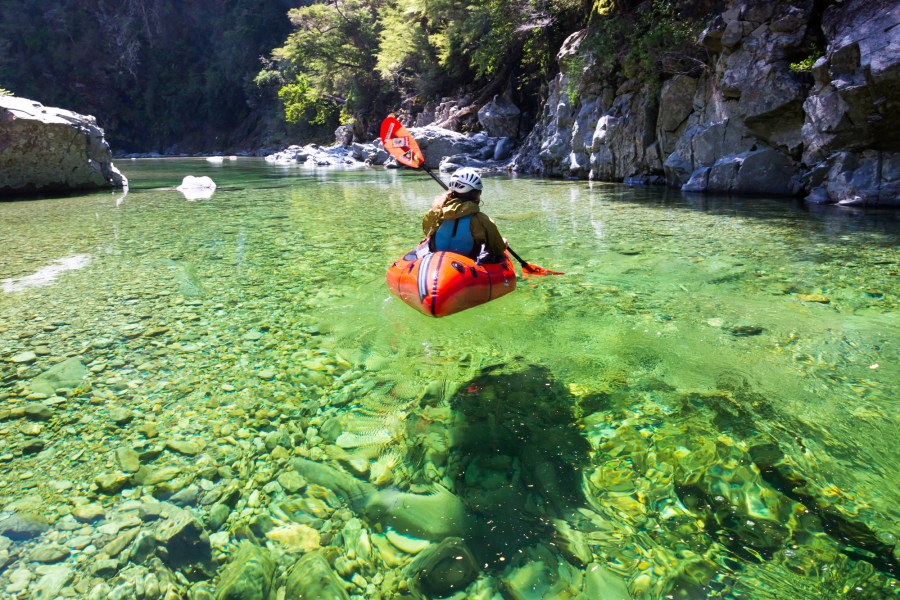
The original Alpacka boats (Small Alpacka, Medium Yak, Large Llama) have been stripped down and streamlined to sell as the most affordable option. I suspect this is largely to compete with the China-made packrafts now on the market.
These boats are light, durable, and capable. The boat design is appropriate for Class III and IV water, with thigh straps. Thigh strap options are:
- Alpacka factory retrofit: Backband and straps on used boats for $350. Note that Alpacka does not offer factory-installed straps on new Classics! This is part of their effort to streamline and offer a more affordable (but capable) boat.
- Install them yourself ($165 + glue for the Alpacka 4-pt, or about the same for AIRE/NRS 2-pt).
I am very attached to having thigh straps, whitewater deck, and a cargo zipper. If I lived in a warmer climate, or sitting in the boat for an hour instead of a day, I would be interested in the self-bailer build.
The Classic boats are more stable than the Wolverine and less stable than the Gnarwhal (below). The Classic is a great option for new boaters.
Expedition
Best for: Remote trips with significant hiking and the possibility of Class III rapids.
The Expedition is listed in the Alpacka Series, because purchasers are likely deciding between the Expedition and Classic. The Expedition is simply a stripped-down Wolverine, with a shorter seat (boat floor becomes less rigid) and optional thigh straps. Without thigh straps, the Expedition is 0.7 (S) – 0.9 (L) lb lighter than the Wolverine.
Expedition vs. Classic
- Weight: The Classic is ~0.5 lb lighter than the Expedition.
- Stability: The Classic is more stable than the Expedition.
- Thigh straps: Easy factory upgrade on Expedition vs. DIY/retrofit on Classic.
For me, the Classic vs. Expedition vs. Wolverine decision comes down to thigh straps. I’m addicted to thigh straps, and I want them for everything, even Class II water. I want the option of at least running ‘backcountry’ straps on remote trips, 3/4″ accessory straps between user-installed foot and thigh tie-downs. Assuming you want straps (you do!) then it becomes a question of minor weight differences.
My solution is to go with the Wolverine, replace the full-length seat and thigh straps with a short seat and accessory straps for remote trips. This is ~equivalent to ordering the Expedition, with thigh-straps, and purchasing the long Wolverine seat as an accessory.
Refuge

Best for: Traditional ‘pack’ rafters looking to save weight without sacrificing the spray skirt and cargo zipper—accessories that make backcountry paddling much more pleasant.
Alpacka’s R&D efforts in the 2010s prioritized the whitewater series (see below), leaving some old-school packrafters feeling abandoned. Sure, the new boats were more capable, durable, and comfortable … but they were also heavier. What about a boat for backpackers looking to save weight and paddle mostly Class I and II water?
The solution was worth the wait. The Refuge is a very capable boat in a tiny package. The weight savings are largely in the tube diameter (10 inches, the same as the ultralight Scout) and thinner fabric. The addition of the spray deck, cargo zipper, and thigh straps brings the boat weight up to just under 7 lbs.
Alpacka undersells how capable this boat is. I’ve paddled it at the top of the weight recommendation (250 lbs passenger + cargo, the recommended limit is 275) and in Class III big water and Class IV creeks. It is a very responsive boat and a ton of fun to paddle. I love the snug hull. In some ways, it feels more like I’m in a kayak. And it is so light that it is easy to maneuver through complicated rapids.
My model has four-piece thigh straps and I see that the current model (V3) has two-piece. That might make it feel less maneuverable.
Whitewater Series
Alpackalypse (Discontinued)

The Alpackalypse had small (9.9″) diameter tubes that gave it a very edgy feel, most similar to a river kayak. The boat was best-suited for experienced kayakers, who appreciated the familiar edginess and roll-ability. With the introduction of the Wolverine, the Alpackalypse was discontinued. And now, the Valkyrie has filled and exceeded the role of the Alpackalypse.
Valkyrie V3

Best for: Experienced paddlers seeking high performance on technical creeks and rivers.
The Valkyrie is the most technologically advanced packraft that I’ve paddled (A Weekend with Packrafting’s Elite: Black Canyon). If you start tipping over, an additional floor panel will hit the water and stall your rotation providing another opportunity to brace and keep upright.
The Valkyrie is Alpacka’s ingenious solution to the ‘secondary stability problem.’ Secondary stability refers to the stability of the boat while on edge. Packrafts have excellent primary stability (flat) and terrible secondary stability because the hull tubes are perfectly round. Why does it matter? Without secondary stability, a boat that is knocked on edge (by leaning or turbulent water) is likely to capsize. Alpacka’s solution is a high-pressure semi-rigid floor that creates chines—hard edges. Unfortunately, building these boats is very labor-intensive and therefore expensive.
Gnarwhal

Best for: Big-water boaters or less-experienced paddlers seeking a boat that feels safe and stable.
The Gnarwhal is the largest and most stable boat in the Alpacka lineup. The Gnarwhal is ideal for big-water, like the Grand Canyon. The volume is double the Alpackalypse, and the boat can survive pretty much anything you throw at it. The trade-off with large tubes and high-volume is that the Gnarwhal is snow to initiate, and the paddler often feels along for the ride. Fortunately, it is a very forgiving ride.
The Gnarwhal will also appeal to new boaters who have no intention of using it on white water. The boat’s size and stability makes it the most forgiving and safest-feeling craft in the lineup.
Wolverine

Best for: Creek boaters, playful boaters, and people that want a one-packraft-does-all solution.
The Wolverine combines the best features of the Alpackalypse and Gnarwhal. The intermediate diameter tubes (10.6″ compared to the Gnarwhal’s 11.7″) result in a ~0.4 lb weight saving over the Gnarwhal, and more stability than the Alpackalypse. The Wolverine is less stable than the Classic.
Compared the the Gnarwhal, the Wolverine feels like a bullet. Initiation is easy, and the boat picks up speed quickly, allowing for a very playful nature, including snapping into eddies and boofing ledge drops. I was shocked by how well the boat surfs. The Wolverine will appeal to kayakers and packrafters that want to paddle technical water. The boat is less stable than the Gnarwhal, which, for me, will result in a few more swims, or “roll practice.”